Translate

Tuesday, September 20, 2016

Pay Yourself First


I watched one short video clip by Ken Chee talking about this concept called, “Pay Yourself First”. Video is here: https://www.facebook.com/ken.chee/videos/10154042215248722/ I would like to take down notes on what he said first, then followed by my own comments (PLEASE read until the last paragraph).

Below is exactly what the trainer said, not me. Here it goes.

The school teaches us that the income we earned minus the expenses (paying off our bills) and if we manage expenses well, we should have good savings. And this is the wrong concept. Please do not teach that to your children.

+ INCOME

-  EXPENSES

+ SAVING

The key concept is very simple, it is called, “Pay Yourself First”.

We should change the sequence. Whenever we receive the income, we should pay ourselves first. Saving comes first. We should pay ourselves and put the money into an untouchable account (pay myself account). Whatever left over, I then to decide what to pay.

+ INCOME

+ SAVING

- EXPENSES

This is what we called the one degree tweak (one degree difference). You will discover two interesting points after you diligently exercise “pay yourself first”.

Point 1: You will have a sizeable saving in your so called asset account. The money here is able for you to start to deploy at assets. (Asset is anything that generates cash flow).

Point 2: You will form a long term habit in your spending. Once you pay yourself first, you will decide carefully how to spend your remaining, how to stretch your dollars and once you survive, it forms a habit.

Please teach this to your children.

We will use the money in the untouchable account on assets. Once the assets generates cash flow, we deploy the” pay yourself first” rules again and it will become a very powerful compounding machine.

Of course, if you do not know how to invest in the right assets, you also will loss money, that is why you must know how to manage the assets well, then the trainer goes on to invite you to attend his workshop on how to manage the assets, called Value Growth workshop.

 That’ is it.

All right, below are my comments.

As a trainer, you always need to come up with new ideology so that people are attracted at first glance. I am not against it but most of us are already doing it without our notice. It is a nice idea actually. I will teach that to my kid, simply because it sounds logic and it sounds cool too.

Take myself as an example, when I started to work in Singapore, my salary is as well close to S$3,000 per month and yet I have also exercised “pay myself first” concept. When the salary was banked into my saving account, immediately the incomes are automatically deducted (GIRO) to pay my “savings”, which is Investment Linked plan (ILP), Endowment plan (EP) and Whole Life plan (WLP). (For me, I treated these three instruments as my long term saving plan). I have been paying these 3 plans since year 2004. All right, of course, there is argument on how much returns are these plans are worth after 50 years, etc. But that’s not the discussion here. At least I am doing the savings part too!

I also started to pay myself even more 4 years ago by contributing additional S$7,000 into CPF SA account as well as S$15,300 into SRS account (to buy blue chip stocks that generates dividends and good growth). Both attract a sizeable amount of tax savings plus savings with good interest for SA account (4% to 5%).

So literally, my flow would be:

+ INCOME

+ SAVING (ILP, EP, WLP)

+ SAVING (CPF SA)

+ SAVING (SA)

- EXPENSES

+ SAVING (remaining)


Now here comes the interesting part.

  1. How to manage the savings in the untouchable account that the trainer is talking about?
     
  2. What assets are we choosing?

It can’t run away from stocks (that includes ETF, REITS, warrants etc.), real estate properties (be it Singapore, Malaysia, Australia, UK, etc.), bonds (fixed income assets), GOLD, oil commodities index, etc. And I am sure experts are digging into each asset and tell you how to select the best among the best.

But, life is not always about me, myself and I.

I would like to share one of the revelation I have in recent years. I know you are here for financial information but probably, this is the most important blog that you must read in your life. I started my tithing journey on November 30, 2014. If you do not have revelation, don’t tithe.


Tithing simply means take 10% of our income and give to our mighty God as 100% of ours are from God anyway, don’t you think so?


Offer our 10% to our God and He will sanctify the rest of our money (90%). Our God is faithful and He knows how to give us the best, not only in the heaven but on the earth as well. I am not here to preach you gospel but I am sharing my revelation to you. If you want to know more about it, you should visit our lovely church at the Star, Buana Vista.

 So, my sequence is actually looks like this. It is called, “Pay Jesus First”.

+ INCOME

- JESUS (10%)

+ SAVING (ILP, EP, WLP)

+ SAVING (CPF SA)

+ SAVING (SA)

- EXPENSES

+ SAVING (remaining)

I am more than happy to share more breakthroughs in my life (if any, ha ha..) in the many “revisions” to come and I am anticipating it too! May all the glories go to the mighty one, our lovely God !

“Bring all the tithes into the storehouse, that there may be food in My house, and try Me now in this, “ says the Lord of hosts, “If I will not open for you the windows of heaven and pour out for you such blessing that there will not be room enough to receive it.” Malachi 3:10.


Thursday, August 25, 2016

Nusa Heights Service Apartment - My first Iskandar property investment (Revision 03)

Revision 03: Updated on November 28, 2021
Revision 02: Updated on December 6, 2020

I bought a FREEHOLD , 3 bedrooms service apartment unit at Nusa Heights, Block A, on 18 February 2012.

The size is 1,050 sq ft and it is a high floor unit, east sun facing, corner unit with 2 car parks.

The SPA price was RM 392,000
The developer gave 8% discount, hence the Net Selling Price was RM 360,640.

I paid 2% down payment RM 7,840 to secure the unit.

I took a 90% loan and capitalized MRTT Premium RM3,220 into the loan, the total loan amount was RM 356,020. I spread the loan tenure year to maximum at 38 years and monthly mortgage payment is RM 1,564.


How is the project doing so far?

Let's talk about the spending first.

(1) I started to pay loan interest only in November 2012 all the way until May 2015 while collecting the keys. So, the total loan interest I had paid was RM 21,485. That is rather a big sum of interest paid. If you buy the unit at the resale market, say in June 2015, you literally save this amount of RM 21,485! And guess what, the loan interest paid will continue to grow with years.

(2) I got 1 month rental + 1.5 month rental + 12 months rental. The total 10% agent fees I have paid was RM 2,325

(3) I spent RM 12,411 on furnishing (see the details below) as well as some miscl. furnishing cost up to RM 714 (to cater for short term stay of 1 month ).

(4) I also paid Assessment Tax to the Johor state, we call it Cukai Pintu or Cukai Harta. It is RM 714 per year.

With the above 4 items, I have spent RM 37,649.


The unit is tastefully renovated and furnished, don't you think so?


The entire unit comes with the false ceiling with down lights.


Now, let's talk about the receivables.


(1) The developer paid me the late delivery interest (they are late for few days only) of RM 751.78.


(2) I received FREE renovation, commission from renovation contractor and the real estate agent while I am doing the marketing, total amount of RM 25,625.


(3) I also received 1 month rental (RM 2,500) , 1.5 months rental (RM 3,750) & 12 months rental secured (RM 20,400), total rental : RM 26,650.


With the above 3 items receivable, total amount is RM 53,027.

So, total receivable of RM 53,027 - total spending of RM 37,649
= RM 15,378 ( a mere net profit).

The unit has a current bank valuation of RM 470,000 only. That is pretty sad. I am aiming for RM 650,000 at least one day.

The developer is giving 3 years FREE maintenance fees.


My monthly loan payment is RM 1,564 and the rental is RM 1,700 per month. So long your rental can cover the monthly loan payment, you shall be doing fine.


The rental yield is 5.66%, nothing too great to shout.


My second investment property in Iskandar will be completed by 4th quarter next year (2017). It is the first service apartment at Sunway Iskandar. I am targeting to market the Sunway Citrine service apartment unit at Airbnb platform when it is completed and fully furnished.

Revision 02: Updated on December 6, 2020
=================================

The new tenant will move in on December 30, 2020.
The new rental yield now is only 4.00%. 


Revision 03: Updated on November 28, 2021
==================================

On November 27, 2021, the tenant decided to renew the tenancy agreement with the same rate.
Rental yield stands the same as 4.00%.

Spent RM5,680 for the above unit toilet internal piping leak. 
(That's 50% of the repair cost, shared with the owner of the above unit).
Next year 2022 operating expenses estimated to be : RM 4,743.60.
Operating expenses such as: agent fees, service charge & sinking fund, quit rent, cukai harta and fire insurance.
Indah water bill paid by the tenant.

Net Gain (up to Dec 31, 2021): RM 91,354.26
Gain of RM 751.78 from the developer late delivery interest (2015)
Gain of RM25,625 from the renovation contractor (2016)
Rental received : RM 100,310 (from 2016 to 2021).

Wednesday, July 13, 2016

Travel Insurance: Tokio Marine (TM) Xplora Annual (Classic Family)

Let's talk about travel insurance. I never buy travel insurance until my son was born. Before I bought the travel insurance, I also do not have any baggage delay or travel delay during my personal holiday. Isn't that cool ? Typically, people tend to pay a small sum for travel insurance per trip per person. In view of frequent travel with the family within a year, I decided to buy a family travel insurance, covering worldwide.


I picked Tokio Marine (TM) Xplora Annual (Classic Family) Travel Insurance.


It is my 3rd time buying this same TM Xplora Annual (Classic Family). The latest one is dated from February 4, 2016 to February 3, 2017.


The usual price of such worldwide classic coverage for family per year is S$453.


I forgot how I got 15% discount. I paid S$385.05 by using credit card (to collect points of course).
It is actually a very good deal if you travel a lot in a year or you have a big family.


This is the emergency contact to keep.


The coverage of the classic plan is shown below.


And the comparison between the Premier and Classic coverage.


Do take note that some of the coverage amount are exactly the same for Premier and Classic, for example, the travel delay and baggage delay are cap at maximum S$1,000 for both Premier and Classic.


For this year, we have made two claims. The latest one was my wife Hokkaido trip, flying from Singapore to KL then KL to Hokkaido. The flight from Singapore to KL was delayed for 2 hours. Hence, once she reached KLIA 2, she had to rush towards the boarding gate and she managed to board the plane as the last passenger.

So obviously, the luggage in the SG-KL plane is not able to be transferred to the other plane on time. So, she was aware that the luggage will not reach the destination once she arrived at Hokkaido. She bought Uniqlo cloths at the airport in Japan and continued her journey.

At the end, the luggage reached the hotel 48 hours later. So, the baggage delay claimed was max at S$1,000, measuring S$200 per 6 hours block. Baggage delay is fine but not baggage loss! So, the S$1,000 claim can help to pay her entire SG to Hokkaido airfare as it was an AirAsia budget flight and plenty more to spend !


The other claim was Micah doctor visit at the specialist at KL, total claim S$337.10. That's the two claims so far in this year.

The claim process is easy. Just fill up the form online through the website below. Thereafter you submit all the relevant document in PDF format, such as the passport details, boarding pass and the baggage delay reports.


While I was on the flight (March, year 2013) from Singapore to Washington D.C., transit at Dubai, my Emirates flight was delayed for 24 hours. All hotel stay and meals were provided by Emirates and that delay also entitled for travel insurance claim, travel delay. It was bad luck enough that even my return flight from Washington D.C. to Singapore, transit at Dubai, the flight was once again delayed for 24 hours (I was actually well prepared for this as the boarding time at Washington was delayed for 1.5 hours). So with both trips delayed, I was able to claim travel insurance max. of S$1,000 not with my personal travel insurance but with my company travel insurance as it was a business trip. You only can claim one travel insurance at a time.

Based on my record, we claimed S$417 doctor visit fees at KL for Micah in year 2014.


http://happysgpregnancy.blogspot.sg/2014/12/year-2014-micah-medical-bill_22.html


We also claimed S$552 doctor visit fees at KL for Micah in year 2013.


http://happysgpregnancy.blogspot.sg/2014/01/year-2013-baby-micah-medical-bill.html


That said if you have kid travel with you, you better buy family travel insurance. It is important to ensure that all the family members are well covered during the oversea trips as the cost is only S$385 per year per family , worldwide coverage.


Monday, February 29, 2016

Year 2016 Tuition Fees at Local Universities in Singapore (NUS , NTU & SMU) Revision 03

Revision 03: updated on August 28, 2019
Revision 02: updated on January 14, 2019
 
I have the latest figures (Year 2016) of the tuition fees at all 3x local universities in Singapore. Please take note that all fees are quoted in year 2016 annual subsidized fees. It means while you work for the first 3 years, you are slowly paying back the "subsidizes" to the government.

Somehow, the NUS and NTU fees are calibrated very close to each other, if not, exactly the same.

An engineering degree at NUS/NTU will cost you: S$31,800.

A business degree at NUS: S$37,400 while SMU: S$44,800.

Medicine at NUS: S$101,600.

Take engineering course as an example, S$31,800 for 4 years school fees, it is considered very affordable at today market.


For my curiosity, I just checked my U.S. university latest school fees in Michigan for the engineering course.

Undergraduate US$12,993 flat rate for one semester (1 year 2 semester, Fall & Winter), so US$12,993 x 2 semester x 2 years = US $51,972 ( lower level) + US$14,400 x 2 semester x 2 years) = US $57,600 . Total of 4 years school fees: US $109,572 = S$158,879.  And you are paying only S$31,800 in NUS. It is 80% cheaper.


Of course, the reason of the big differences are: you are studying in Singapore as a Singaporean versus studying in the United States as a non-resident (foreigner), that is why the cost has the big difference. Also, not everyone can enter the local university in Singapore, your A-Level grade must be good.

There are also some ways to reduce the cost of oversea studying by studying the first two years locally before doing the program exchange in the US, but the most you can save is about 50% of the total tuition fees quoted above in USD. After all, the price difference is still quite significant. Not to forget to add in the cost of residence, living expense, health insurance , etc.

So long the school fees increment is kept at low pace, I believe the tuition fees in Singapore is still within the reach.

To complete a Graduate program require 33 credit hours of course works. Hence, a Master degree in engineering will cost US $1,123 x 33 = US $37,059 = S$53,735. In other words, my certifications now has a market value of US $146,631 = S$ 212,614. That's crazy, how many years I have to work in order to breakeven that school fees ! :(

Good luck , kids, same goes to the parents. :)
 
Updated on January 14, 2019
=======================
 
All tuition fees increment are kept at a very reasonable pace.
 
From year 2019 onwards:
 
An engineering degree at NUS/NTU will cost you: S$32,800.
Tuition fees increment of 3.1% throughout 3 years.
 
A business degree at NUS: S$38,400 while SMU: S$45,800.
Tuition fees increment of 2.7% throughout 3 years for NUS and 2.2% for SMU.
 
Medicine at NUS: S$113,600 while NTU: S$136,800.
Tuition fees increment of 11.8% throughout 3 years for NUS and 4.6% for NTU.


Updated on August 28, 2019
=======================
 
Tuition fees for Singaporeans ! Still affordable, I shall say.


Monday, December 14, 2015

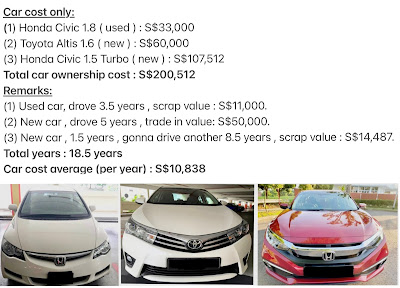
HONDA & TOYOTA (Revision 05)

HONDA CIVIC 1.5 TURBO: (Year 2020 - Present)
TOYOTA ALTIS 1.6: (Year 2015 - Year 2020)
HONDA CIVIC 1.8: (Year 2012 - Year 2015)

Just the car cost itself (with COE of course), the total car ownership cost for 18.5 years is S$200,512. 

In average, S$10,838 per year.


Revision 05 (last paragraph): updated on January 4, 2022.
Revision 04: updated on February 28, 2021.
Revision 03: updated on September 29, 2020.
Revision 02: updated on December 15, 2015.

I bought my first used car in April 2012. A pearl white Honda Civic 1.8 lit with a price tag of S$44,000. I have scrapped the car earlier in November 2015 with a return value of S$11,000. My COE will be expire in February 2016 instead.

So, literally, the car cost was S$33,000 for 3.5 years of usage (after getting back the car scrap value).

My beautiful used car:


April 2012 - car mileage was 84,206 KM
November 2015 - car mileage was 117,064 KM

In this 3.5 years of car usage, the car mileage clocked total of 32,858 KM.

In average, I run the car for 9,388 KM per year.


I finally know why everyone said Honda Civic is a reliable car.

For the past 3.5 years , I only spent S$2,344 for the car maintenance. It is average S$669+ per year! I only do car standard maintenance once in a year !

The Honda Civic car engine gave me zero problem for a nearly 10th year old car, can you believe it ? Zero problem !

Out from this S$2,344 car maintenance cost, it is good to point out the following items:

(1) I spent S$500 for 4 pieces of new car tyres.

(2) I changed my car battery in October 2012 and it still run well in November 2015 ! The car battery last for 3 years and more ! It is worth to mention the car battery is AMARON (12V 45 MAH type).

 
Of course, you have to pay insurance and road tax every year.
 
Road tax for 1.8 lit car is S$978 per year.
 
Car insurance average is S$1,600 and it will go lower and lower. I have yet to reach the 50% no claim limit discount.
 
Last but not least, you also need to include the car park fees and petrol cost.
 
In summary, I love Honda Civic car a lot. It is truly a fun car to drive.
 
I have since bought a brand new Toyota Altis in November 2015 and I will share more about the experience with Toyota here. Of course , Honda Civic is better than Altis but in terms of price, of course, Altis presents a much better value car, that is the key reason I bought Altis especially the new version of Altis looks so much better than the older generation, so, why not give it a try ?
 
So, this blog will be a continuous blog of my car experience with Toyota Altis thereafter. :)
 
Updated on December 15, 2015
=======================
 
Toyota Altis: (mine is pearl white again)


I bought a new Toyota Altis in early November 2015 with a price tag of S$110,000 nett.


It is a 1.6 lit. pearl white elegance series. It is a free upgrade that worth S$7,000.
 
This also include free 1 year servicing (4 times @ 1,000 KM, 5,000 KM, 10,000 KM and 20,000 KM). It has 5 years warranty for the car engine with unlimited mileage.
 
It is worth to take note the road tax for 12 months is now S$594 for a 1.6 lit. car.
 
The COE secured is S$56,001.
 
Do let me know if the Altis elegance series price start to drop below S$110,000 level. That has to be in line with the COE price drop, obviously.
 
My new baby now:


After driving almost 900 KM with Toyota Altis, let me share some views of this car in comparison with Honda Civic.
 
What I like:
 
(1) The price is great. At least it is cheaper than Honda Civic by S$15,000. I can use the price difference for Altis maintenance cost for 10 years ! :)
 
(2) The car looks great. The doors look like Lexus IS250. :)
 
(3) Even though it is a 1.6 lit car, the power is still not bad, acceptable.
 
(4) The noise isolation of this Altis is superb. It is extremely quiet once you close the door. I am impressed.
 
(5) Extremely fuel efficient. I will share more on that.
 
(6) And many more small little items like key less ignition, electric adjustable seat, built in GPS, auto LED light.
 
What I think it can be better:
 
(1) The steering wheel is too light for me but I somehow get used to it.
 
(2) The movement of the gear box is like a toy. Oh boy, luckily I don't have to change gear often like a manual car. The movement is not shiok like Honda Civic.
 
(3) The car compartment design is really bad. They should just copy Honda Civic. Civic compartment in the car is super.
 
Toyota Altis has a scrap value of S$9,800
Honda Civic scrap value is S$10,000
Honda City scrap value is S$4,500.
 
I have once calculated the standard and major maintenance until 80,000 KM ( I probably only able to clock 80,000 KM in 10 years time or lesser). The maintenance cost would be S$ 1,575 for 10 years from Toyota Service Centre. That's not too bad indeed. (The cost breakdown will be shared in the next revision).

Updated on September 29, 2020
=======================

I will trade in the Toyota Altis on October 13, 2020 for S$50,000 and I lost the car scrap value of S$9,800. 
Technically speaking , I paid S$60,000 to drive the new car for 5 years.
S$12,000 to own the car for a year. 
I have driven about 75,000 KM.

My next servicing is scheduled to be end of Q4 2020 and I skipped it due to the trade in.

Hence, my maintenance cost for this car was S$3,769.20. It includes new tyres cost of S$565.
In average, I pay S$753 per year. The cost does not include the road tax, VICOM car test, ERP, car park fees, etc..


As for the car insurance paid for the past 5 years, total paid: S$4,300++.


Goodbye Toyota Altis.

It is indeed a good reliable Japanese car. No problem at all. 


Updated on February 28, 2021
========================

(1) 13th October 2020
- New car collection!
- FREE 6 months road tax worth S$342.
- 5 years extended warranty (unlimited mileage)
- FREE 3 years servicing (7 times or up to 60,000KM)
- FREE front recording camera
- FREE Honda coilmat
- COE: S$41,510
- KahShield Undercoating/ Rustproofing, paid S$256.80.
- After 10 years scrap value will be S$14,487 (Minimum PARF Benefit)

(2) 30th October 2020
- paid S$540 for BlackNano coating (including windscreen coating on all glass panels, GYEON RIMS coating on all 4 rims, Interior coated with GYEON leather COAT and head and tail lamps coating. 36 months warranty, where covering gloss, uneveness of coating as well as peeling and cracking on the coating.

(3) 13th November 2020
- FREE first car servicing
- used Shell Helix Ultra 0W-20 Fully Synthetic Motor Oil

For the past 5 months car driving experience, I only can say this Honda Civic 1.5 Turbo indeed is a fun car to drive! 

Simply LOVE it !


Picked latest color in year 2020: Coffee Cherry Red Metallic.


Divine Exchange. :) Traded in 5 years old Toyota Altis for S$50,000.


Honda Civic 1.5 Turbo engine.


After NanoBlack coatings.


Used during the first FREE car servicing at Honda Service Centre.


Updated on January 4, 2022
========================
One year detail expenses for Honda Civic 1.5 Turbo are shown below.
Keep track the petrol usage for fun. : ) 
The Honda Civic 1.5 Turbo has a petrol tank size of 47 liters.
One year net car petrol cost S$2,136.77. 
That's S$178.06 per month.
Total distance traveled within a year: 12,378KM.
Total 1 year spent (1st year) : S$3,489.86 . Average per month: S$290.82.

I don't have to go through ERP gantry to work and also no ERP gantry when I drive back home.
I also do not have to pay for car park fee at work place as well as the residence place.

However, I do have to pay car park fee elsewhere and that can round out the average spent per month to be S$300.

Our CPF at the maximum ...

A Singaporean household of 3. 2 working adults, age 46 (1980s) and 1 young adult age 14. Voluntary Housing Refund (VHR) all monies back to C...